 Nftx
Nftx
Nftx V4 listing fees, price multiples, and prepaid duration
Nftx V4 charges prepaid listing fees in collection tokens based on the asking multiple and listing duration. A higher multiple or longer period increases the standard fee and reduces the initial token payout. Collection-specific settings determine the permitted terms and the effective calculator.
In short: Extending a liquid listing delays its trailing auction and raises the standard prepaid fee when the floor multiple stays unchanged.
Draft terms before committing the NFT
A premium listing normally starts with a chosen floor multiple, a permitted duration, and a collection-token fee quote. An unsent draft allows changes to expensive or invalid terms. Reducing the requested duration can reduce prepaid tax under the standard calculator. If that shorter period falls outside the collection’s limits, retain a permitted duration and reconsider the asking multiple. Transfer authorization remains a separate prerequisite; repricing does not repair missing permission. Editing a quote moves neither the NFT nor the collection tokens. The listing transaction commits the selected terms when it executes successfully.
An NFT approval authorizes transfer. It does not create a listing or pay its tax.
Collection identity and the fee quote
The fee uses the ERC-20 token associated with the NFT’s registered collection. A matching ticker alone does not establish collection identity. The collection contract and its corresponding token must match the NFT being listed. Collection vaults hold the deposited NFTs, so listing changes custody of the item even when the seller retains its premium claim.
For an integration,
getListingTaxRequired
quotes tax for the listing terms and collection. Those terms include the owner, creation time, duration, and
floorMultiple. Duration uses seconds, while the multiple uses two-decimal encoding:
100
means 1.00x. These inputs describe a collection-token price, not a fixed currency valuation. The quote and creation request need to use the same intended terms.
Permitted multiples and durations come from the effective
listingConfig
for the collection. Liquid and Dutch listings have separate duration bounds. The effective
taxCalculator
can also differ between collections. A fee copied from another collection therefore cannot establish the tax payable for this NFT.
The standard price curve and duration scaling
The price component
Multiples up to the curve’s bend
The standard curve uses the square of the full asking multiple in its lower range. It does not square only the premium above one floor token. Within that range, increasing the multiple raises tax faster than a proportional price increase. The fee quote expresses that cost in the collection’s token.
Multiples above the curve’s bend
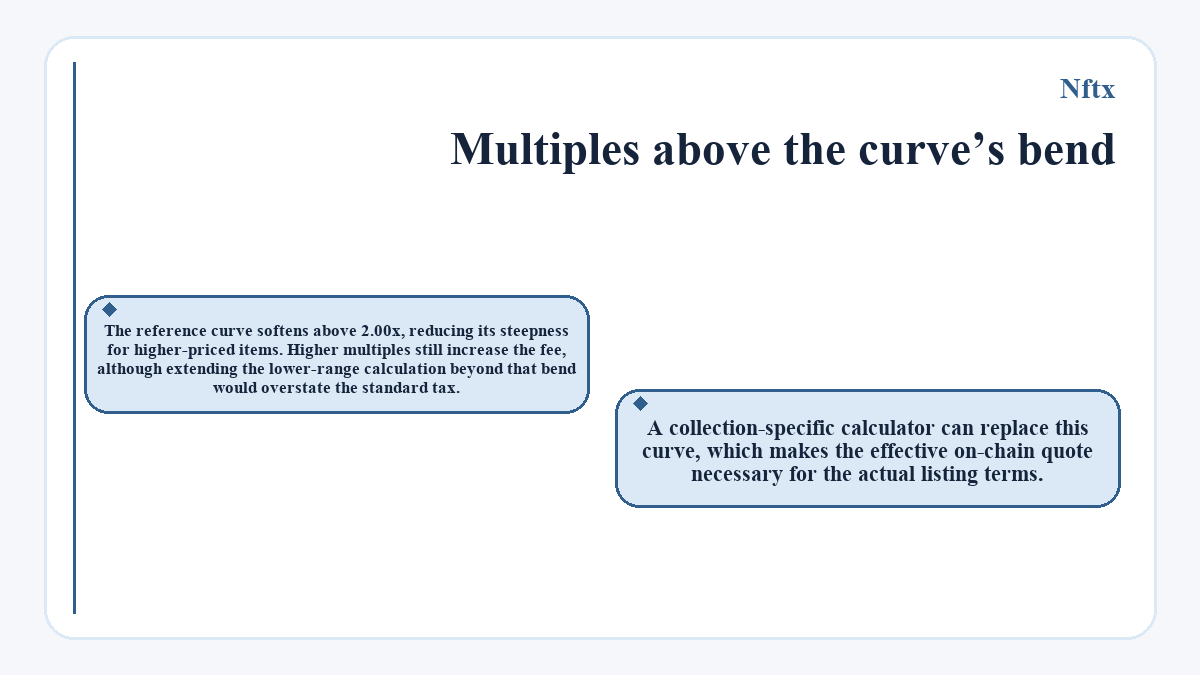
The reference curve softens above 2.00x, reducing its steepness for higher-priced items. Higher multiples still increase the fee, although extending the lower-range calculation beyond that bend would overstate the standard tax. A collection-specific calculator can replace this curve, which makes the effective on-chain quote necessary for the actual listing terms.
The time component
At a fixed floor multiple, the standard listing fee scales linearly with prepaid duration. Doubling a permitted duration therefore doubles that fee when the calculator and price remain unchanged. The relationship describes prepaid listing time; it does not predict how quickly a buyer will purchase the NFT. Both durations must satisfy the collection’s configuration.
The liquid period and its trailing auction have separate clocks. A longer fixed-price period postpones the auction’s start.
A smaller fee before submission
Consider a hypothetical draft for one eligible NFT that remains in its owner’s wallet. Its permitted duration produces a fee quote of 0.0278 collection tokens under the standard calculator. The asking multiple remains unchanged throughout this comparison. Against the gross mint of one token, the initial net payout would be 1 - 0.0278 = 0.9722 collection tokens.
If halving that duration remains within the collection’s bounds, the revised fee would be 0.0139 tokens. The draft’s net payout becomes 1 - 0.0139 = 0.9861 collection tokens. That is the amount left after listing tax, before any conversion into another payment asset. The premium still requires a later buyer.
If the shorter duration breaches the collection’s minimum, the cheaper draft is invalid. Restore the permitted duration before requesting another quote. Stop before submission if the revised terms still fail validation or the payout is unacceptable. The revised draft remains unsubmitted, and the NFT stays in its owner’s wallet.
Unused tax and changes to live liquid listings
A live liquid listing’s owner can revise its price or duration, with higher or longer terms requiring additional tax. Lower or shorter terms can release unused tax, with the refund offset against the replacement tax before an extra amount is collected. Time already consumed remains a cost. Comparing the revised fee with the entire original payment would overstate the refund available late in the listing period.
Cancelling an eligible liquid listing refunds the unused portion of its prepaid tax. Reclaiming the NFT also requires returning its floor-equivalent collection token. That repayment reverses the gross token mint; the refund accounts for unused tax separately. Cancellation is restricted to liquid listings and is unavailable once the listing is Dutch or expired.
Expiry lowers the premium through a trailing auction
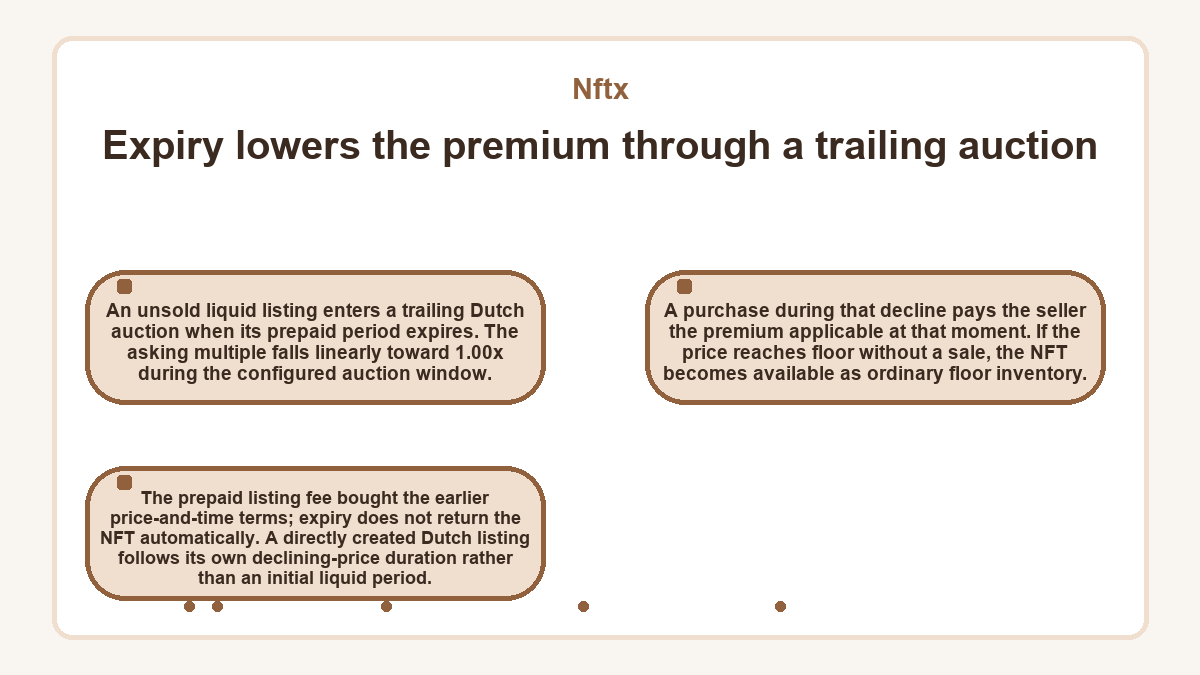
An unsold liquid listing enters a trailing Dutch auction when its prepaid period expires. The asking multiple falls linearly toward 1.00x during the configured auction window. A purchase during that decline pays the seller the premium applicable at that moment. If the price reaches floor without a sale, the NFT becomes available as ordinary floor inventory. The prepaid listing fee bought the earlier price-and-time terms; expiry does not return the NFT automatically. A directly created Dutch listing follows its own declining-price duration rather than an initial liquid period.
Sale proceeds and the buyer’s token payment
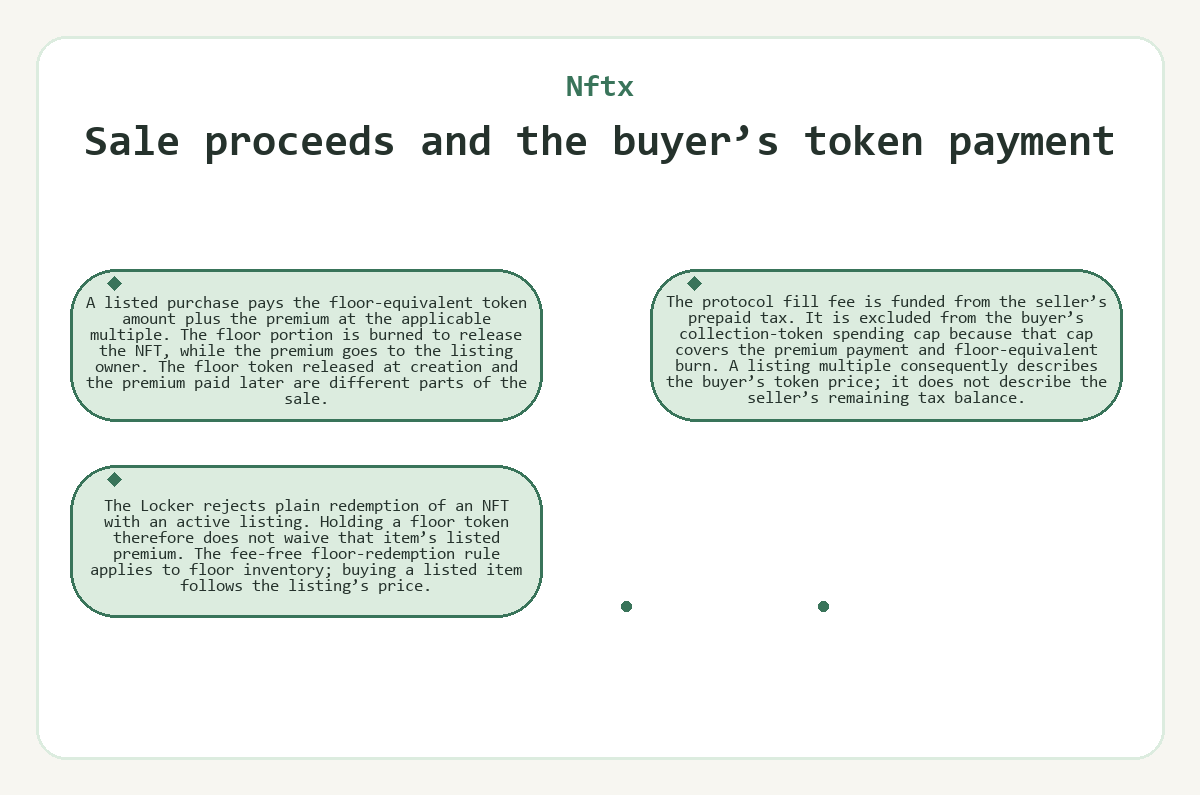
A listed purchase pays the floor-equivalent token amount plus the premium at the applicable multiple. The floor portion is burned to release the NFT, while the premium goes to the listing owner. The floor token released at creation and the premium paid later are different parts of the sale.
The protocol fill fee is funded from the seller’s prepaid tax. It is excluded from the buyer’s collection-token spending cap because that cap covers the premium payment and floor-equivalent burn. A listing multiple consequently describes the buyer’s token price; it does not describe the seller’s remaining tax balance.
The Locker rejects plain redemption of an NFT with an active listing. Holding a floor token therefore does not waive that item’s listed premium. The fee-free floor-redemption rule applies to floor inventory; buying a listed item follows the listing’s price.
Listing revenue and other transaction costs
On Uniswap V4-backed deployments, the liquidity-provider share of listing revenue flows into the collection’s canonical pool through fee donations. Extra token pools do not receive those listing-tax donations. The effective pool fee also informs the split between liquidity providers and the protocol. These allocations concern fee recipients; they do not change the token unit that the seller uses to prepay listing tax.
Converting the released collection tokens introduces a separate swap quote and swap costs. Network gas also remains separate from listing tax. Legacy inventory staking has its own version-specific reward accounting. Its reward percentages do not determine the upfront collection-token payout for a V4 listing.
Still wondering about Nftx?
How does a changing floor-token market price affect prepaid tax?
A market-price change alters the currency value of collection tokens, not the token amount already prepaid. A listing keeps its token-denominated terms unless those terms change or its auction reduces the asking multiple. The currency value of a refund can therefore differ from its value when the tax was paid.
Is listing tax multiplied across NFTs with identical terms?
Each NFT carries its own listing tax even when several NFTs share identical terms. The SDK can quote identical terms together and multiply the per-item fee by the item count. That grouping avoids redundant quote calculations; it does not create a discount on prepaid listing tax.
Why can the SDK refuse a listing-payout quote when the tax calculation succeeds?
The SDK payout helper requires a positive amount of collection tokens after tax. It subtracts total tax from the gross token mint for the selected NFTs. If nothing remains, it refuses the payout quote. A tax calculation alone also does not establish that a separate token-conversion quote is available.
Which figure governs an ETH payout after listing tax?
The ETH payout depends on the swap quote for the collection tokens left after tax. The quoted token balance is the swap input, and expected ETH output is an estimate. The conversion must meet the minimum acceptable output to succeed. Market liquidity and swap costs affect conversion, so subtracting listing tax from one collection token does not establish an ETH payment amount.
Can a liquid-listing modification use escrowed collection tokens?
The modification function supports paying required tax from the caller’s escrow balance. This payment choice belongs to the contract operation and may need specific interface support. It does not bypass ownership requirements or permit changes to Dutch listings. The applicable balance is denominated in the collection’s token.
Does permissionless re-listing require a fresh prepaid fee?
The replacement listing carries prepaid tax for its own price and duration. Permissionless re-listing pays the existing owner the applicable premium and places new terms on the same NFT. The caller cannot be the current listing owner. Changing an owner’s existing liquid listing instead uses the modification operation.
What event confirms that a V4 listing was created?
Successful listing creation emits the ListingsCreated event. The stored listing also records its owner and terms. An approval only grants transfer permission, and a fee quote creates no listing. A signature or submitted transaction hash alone does not establish that the creation transaction executed successfully.
Are legacy mint and redemption percentages part of a V4 listing-tax quote?
Legacy mint and redemption percentages do not supply the V4 listing-tax formula. V4 NFT deposits and floor redemptions have no protocol entry or exit fee, while above-floor listings carry prepaid tax. Inventory-staking reward percentages describe separate accounting. Swap fees and network gas remain distinct costs.
Last updated